
This industry-style review lays out twenty striking findings grounded in official Defra data and related datasets. The provisional household recycling rate (WfH) rose to 44.6% in 2023, and that small change matters when converted into tonnes across the nation.

We flag the biggest shifts up front: biodegradable municipal landfill fell to 5.3 million tonnes, packaging recycling varies by methodology (64.1% to 75.2%), and total generated material was 191.2 million tonnes in 2020.
The piece separates household measures from commercial and industrial activity and explains why comparisons can mislead without clear definitions. It also promises transparency on provisional versus final releases and on revisions to core data.
Twenty facts are grouped by theme — households, landfill, packaging, construction and demolition, and business rules — so you can navigate quickly. Primary sources are Defra releases, WasteDataFlow and packaging databases, with figures explained in plain English.
Key Takeaways
- Household recycling rose to 44.6% in 2023; small rate shifts equal large tonnes.
- BMW to landfill fell to 5.3 million tonnes — a major shift.
- Packaging recycling differs by method: 64.1%–75.2%.
- Total generated material in 2020 was 191.2 million tonnes; England accounted for 85%.
- Article explains provisional vs final data and groups facts by theme for clarity.
Snapshot of the latest UK waste figures and why they matter
The latest Defra release mixes fresh measurements with unchanged time series, so the headlines need careful reading.
What has been updated: provisional WfH data for 2023, BMW landfill totals for 2023, and provisional packaging data for 2024. C&D recovery and total generation were not revised this cycle.
What’s new in the most recent Defra release
New data lift the household recycling rate to 44.6% in 2023. BMW sent to landfill fell by about 1.0 million tonnes (6.3 → 5.3).
Packaging shows two official recycling figures for 2024: 64.1% and 75.2%. The gap comes from different placed‑on‑market estimates, not from higher recycling outputs.
The standout movements and why they matter
- Mixed updates can skew trend interpretation when some series remain unchanged.
- Changes in recycling rate and landfill tonnes affect policy, investment and public information.
- Provisional labels mean a missing local authority return still influences national figures.
Next, the report sets out sources and definitions, then examines households, landfill composition, packaging methods and business obligations.
waste statistics UK: the official sources behind the numbers
Official releases combine multiple data pipelines, so knowing their roles matters.
Defra and the headline release
Defra’s UK Statistics on Waste is the primary publication. It brings together national figures and harmonised measures such as WfH for cross-country household comparison.
How local authority reporting feeds the totals
Local councils submit tonnages via WasteDataFlow. They record collection type, treatment step and destinations.
This council-level reporting forms the backbone of authority collected municipal and collected municipal waste datasets.
Specialist systems and devolved rules
Specialist systems such as the Waste Data Interrogator and NPWD support landfill and packaging measures.
Devolved policy and different calculation rules mean country-level targets and inclusions vary. That makes direct comparisons tricky.
- Three main pipelines: Defra release; WasteDataFlow (local authority collected reporting); specialist data systems (WDI, NPWD, packaging databases).
- What to trust: use WfH for cross-country household recycling comparisons; use packaging databases for producer responsibility figures.
- Common pitfalls: mixing local authority collected figures with all‑flows, or placed‑on‑market packaging with arising tonnages.
We translate those complex data sources into clear figures and actionable context in the sections that follow.
How the UK defines waste streams, recycling and recovery
Clear definitions stop confusion when numbers for collections, household arisings and authority totals differ. Accurate terms and consistent data boundaries explain why headline rates move.
Three official measures and why they differ
WfH (waste from households) is the harmonised household measure. It covers kerbside collections, household waste recycling centres and bring sites. It excludes street cleaning and most construction rubble, soil and plasterboard.
Household waste is broader and adds street bins, parks and some separately collected streams such as small healthcare items.
Local authority collected municipal waste includes household plus non‑household and commercial material that councils collect.
What counts as recycling and what doesn’t
Recycling means material is accepted by a reprocessor and made into products, materials or substances. This includes composting and anaerobic digestion but excludes energy‑from‑waste and backfilling.
Recovery, energy‑from‑waste and disposal
Recovery covers reuse of energy or materials. Energy‑from‑waste raises recovery totals without increasing recycling rates because it turns material into energy rather than new material.
- Common household streams: dry recycling, organics/food, residual waste.
- Contamination: tonnages are recorded at reprocessor acceptance, net of rejects.
- Note: later we explain IBAm (metal recovered after incineration) and how it can alter recycling figures.
| Measure | Includes | Excludes |
|---|---|---|
| WfH | Kerbside, HWRCs, bring sites | Street cleaning, most C&D |
| Household | WfH + street bins, parks | Large commercial collections |
| Local authority collected municipal | Household + council commercial | Private sector collections |
Data revisions and what changed in this update
Small technical corrections in regional datasets have led to modest but important shifts in national totals. These revisions tidy earlier entries and improve consistency across time series.
What a revision means and why it happens
A revision is an authorised change to previously published records. Revisions occur when late local authority returns arrive, methods improve or site returns are corrected. They are a normal part of official reporting and keep the data accurate.
Country-level corrections in this release
Wales had back‑series adjustments for 2019–2022 after a 2022 method change. The new method more readily identifies and excludes street sweeping recycling tonnages. That produced consistent figures across the revised years.
Scotland saw minor updates to the 2022 WfH after some local authorities submitted historical corrections. These were small edits but they update the country series.
There was also a small BMW landfill correction in Wales for 2019, driven by revised site return data. Landfill records evolve as site reporting is clarified.
- Small shifts, large effects: Even modest country changes can move UK totals and the national recycling rate, because England forms most of the tonnage base.
- Best practice: always cite the latest release date, use a single consistent series, and avoid mixing old tables with updated datasets.
- Forward view: subsequent UK vs country comparisons in this article will use the revised series and note these changes.
| Area | Years affected | Driver | Impact on totals |
|---|---|---|---|
| Wales WfH | 2019–2022 | Method change to exclude street sweeping recycling | Back‑series consistency; small tonnage reductions |
| Scotland WfH | 2022 | Historical local authority updates | Minor corrections to 2022 figure |
| Wales BMW landfill | 2019 | Revised site returns | Small landfill tonnage change |
COVID-19 impacts and the longer-term trendline
Lockdown-era changes in daily life left a clear mark on household collections and the national totals that follow. Defra notes that reporting periods overlap with COVID-19 restrictions, so year-on-year totals reflect behaviour as well as policy.
How lockdown-era behaviour shows up in arisings and recycling
Households produced more material in 2020–21: WfH arisings were 27.0m tonnes (2020) and 27.7m (2021). By 2022 and 2023 those tonnages fell to 25.7m and 25.9m respectively.
Recycling rates stayed near the mid-44% band: 44.5% (2020), 44.6% (2021), 44.1% (2022) and 44.6% (2023 provisional). This shows a plateau rather than steady improvement.
- Higher arisings in 2020–21 link to more time at home and different consumer patterns.
- Flat recycling rates can result when both recycled and residual streams change together.
- Operational pressures—reduced crew numbers, site limits and shifting sorting capacity—affected collection and processing during lockdowns.
Interpreting these figures requires consistent definitions (use WfH) and attention to provisional labels and later revisions. Later sections break down country splits and stream-level shifts as normal service resumes.
Waste from households across the UK: recycling rate and tonnes
Household totals and the headline recycling rate both nudge higher in 2023, but the tonnage detail tells the fuller story.
UK household recycling rate in 2023 and the year-on-year change
The provisional UK WfH shows 25,913,000 tonnes of arisings and 11,554,000 tonnes recycled, giving a 44.6% recycling rate in 2023.
That is up from 44.1% in 2022 and represents around a 0.5 percentage point lift. In plain terms, more material was diverted from residual streams into recycling.
Household arisings in 2023 and what is driving them
England accounts for most of the tonnage: 21,717,000 tonnes or 84% of the total. Its provisional recycling rate was 44.0%.
England’s total WfH rose 1.2% year‑on‑year. Residual tonnage stayed broadly flat while recycling grew by 0.2 million tonnes.
Organic vs dry recycling: what moved and why
The biggest uplift came from organics: up ~0.4 million tonnes (+10.8%). Wetter growing conditions and normal garden activity increased garden and green collections.
By contrast, dry recycling fell about 0.1 million tonnes (‑2.4%). Service design at kerbside and sorting throughput help explain these shifts.
How incinerator bottom ash metal affects the headline rate
Including incinerator bottom ash metal (IBAm) adds roughly 240,000 tonnes to recycled tonnage. That boosts the headline recycling rate by about 0.9 percentage points.
Note: Northern Ireland only started including IBAm mid‑2023, so cross‑country comparisons should flag that timing difference.
- Local authority collected systems — kerbside, HWRCs and bring sites — feed the WfH totals and shape the rate.
- Viewing the rate alongside tonnes helps avoid overstating progress when small rate changes mask stream shifts.
| Measure | 2023 tonnes | Change |
|---|---|---|
| UK arisings (WfH) | 25,913 kt | +— |
| Recycled (UK) | 11,554 kt | +0.5 pp rate |
| England arisings | 21,717 kt | +1.2% |
UK country comparisons: where recycling rates are highest and lowest
Comparing country-level data highlights that a high recycling rate is as much about systems as it is about behaviour.
Here are the 2023 WfH recycling rates and arisings by country. Wales leads at 57.0% and Scotland is lowest at 42.1%.
| Country | Recycling rate (2023) | WfH arisings (kt) |
|---|---|---|
| Wales | 57.0% | 1,150 |
| Northern Ireland | 50.2% | 833 |
| England | 44.0% | 21,717 |
| Scotland | 42.1% | 2,212 |
“Best in the country” means a larger share of household material is diverted from residual bins. But it also reflects collection choices, treatment infrastructure and reporting timing.
- Read rates with tonnage: England’s mid‑level rate masks its dominant tonnage impact on national performance.
- Compare carefully: harmonised WfH helps, but IBAm treatment timing and policy differences still affect figures and data.
- Signs of high performance: strong organics capture, effective dry recycling and lower residual tonnage per household.
Focus on both the recycling rate and absolute recycled tonnes when judging progress and investment need.
Landfill reality check: biodegradable municipal waste (BMW) in 2023
Biodegradable municipal landfill totals fell sharply in 2023, and the change reshapes the disposal picture.
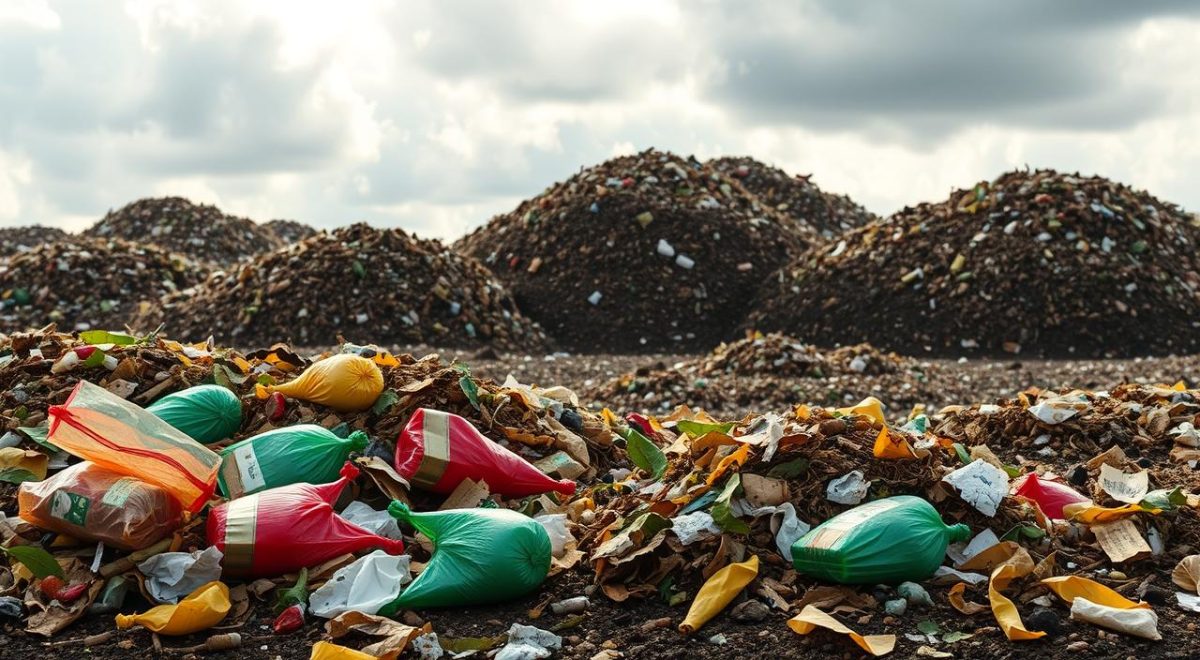
BMW sent to landfill: the 2023 drop in million tonnes
Defra records show BMW to landfill fell from 6.310 million tonnes in 2022 to 5.344 million tonnes in 2023. This 0.966 million tonne reduction matters because biodegradable material drives methane and other landfill emissions.
England’s share and what it implies
England accounted for 4.388 million tonnes in 2023 — about 82% of the UK total. That dominance means England’s collection and treatment systems will shape future landfill reductions across the country.
What BMW includes and how it is measured
BMW covers the biodegradable fraction of municipal disposal, notably food waste, green garden arisings, paper and cardboard.
It is a calculated fraction of municipal landfill inputs, derived using agreed composition factors, not a direct weigh of labelled food at the gate.
- Practical point: better capture of organics and fibre at source reduces biodegradable disposal and lowers emissions.
- Context: landfill tonnage falls can occur even when national recycling rates move only slightly.
| Measure | 2022 (million tonnes) | 2023 (million tonnes) |
|---|---|---|
| BMW to landfill | 6.310 | 5.344 |
| England share of BMW | — | 4.388 (82%) |
| Main BMW components | food, green, paper | food, green, paper, cardboard |
What’s actually going to landfill: main municipal waste types
The 2023 data show final landfill receipts totalled 11.184 million tonnes. Most of that tonnage comes from treatment outputs rather than direct kerbside refuse.
The dominance of mechanical treatment outputs
Defra records list EWC 19 12 12 (wastes from mechanical treatment) at 7.797 million tonnes in 2023. That single category is now the primary landfill stream.
How the landfill mix has flipped since 2010
Mixed municipal waste (EWC 20 03 01) fell to 2.080 million tonnes in 2023. Combined with mechanical treatment residues and ‘Other’, these two classes make up about 88% of municipal disposal tonnage.
- What mechanical treatment means: residual outputs after sorting, shredding and screening at plants.
- That residue can dominate landfill even when collections and recycling change.
- Since 2010 the share of mechanical treatment rose from 38% to 70%, while mixed municipal fell from 54% to 19%.
- Do not assume landfill composition equals what households place in bins — treatment reclassifies flows.
- More treatment capacity changes reporting categories, but it does not remove the need for disposal options.
| Landfill input type | 2023 tonnes | Share of total (approx) |
|---|---|---|
| Wastes from mechanical treatment (EWC 19 12 12) | 7,797,000 | 70% |
| Mixed municipal waste (EWC 20 03 01) | 2,080,000 | 19% |
| Other landfill inputs | 1,307,000 | 11% |
Packaging waste recycling: the provisional 2024 picture
The 2024 packaging recycling rate sits in a range: 64.1% to 75.2%. That spread arises because two denominator methods are used, not because recycled outputs differ.
The NPWD recycling outputs are the same in both approaches. Using NPWD plus PackFlow gives 64.1% (method 1). Using NPWD plus Reported Packaging Data gives 75.2% (method 2).
Material results and where performance differs
- Paper and cardboard: 74.3% (method 1) or 86.4% (method 2).
- Metal: 68.4% or 80.4%.
- Glass: 65.7% or 80.4%.
- Plastic: 51.0% or 53.7% — the weakest performer.
- Wood: 42.4% or 57.3%.
Method 1 totals: recycled 8,154 thousand tonnes from a total arising of 12,727 thousand tonnes. These figures show the scale behind the percentages.
Packaging placed on market covers the tonnes of products producers register as sold into the market. Better reporting and pEPR changes alter that denominator and so the reported rate.
| Method | Overall rate | Key recycled tonnes |
|---|---|---|
| NPWD + PackFlow | 64.1% | 8,154 kt recycled; 12,727 kt arising |
| NPWD + Reported Data | 75.2% | 8,154 kt recycled; larger placed-on-market total |
Next, the article will examine PackFlow versus Reported Packaging Data and why pEPR is changing how producers report packaging.
Packaging recycling methodologies: PackFlow vs Reported Packaging Data
The same recorded recycling tonnage can give two very different rates when the denominator changes.
Methodology differences that change the recycling rate
Both approaches use NPWD for recycled tonnages. The lone variable is the total placed on market.
Method 1 pairs NPWD with PackFlow, a modelled flow estimate of packaging supplied. Method 2 pairs NPWD with Reported Packaging Data, a producer‑submitted dataset for H1/H2 2024 (data as at 2 June 2025).
How to interpret “placed on market” vs “arising” estimates
Placed on market is supply into the economy; it helps set compliance obligations. Arising or arising estimates refer to packaging that becomes household or commercial material destined for collection.
Use placed on market when discussing producer responsibility, and arising when judging collection and processing performance.
What pEPR means for future packaging reporting
pEPR (from 1 Jan 2025) formalises producer reporting requirements. That should improve data quality and may prompt a re‑base of time series.
- Always state which method you cite to avoid confusion.
- Clear methodology supports government accountability and auditable figures.
| Aspect | PackFlow (method 1) | Reported Data (method 2) |
|---|---|---|
| Recycled tonnage | NPWD outputs (identical) | NPWD outputs (identical) |
| Placed on market estimate | Modelled total (PackFlow) | Producer‑reported totals (H1/H2 2024) |
| Headline effect | Lower overall rate (e.g. 64.1%) | Higher overall rate (e.g. 75.2%) |
Construction and demolition waste: high tonnage, high recovery, high uncertainty
The construction and demolition sector drives volumes far beyond household collections, shaping national totals.

Key benchmark: non‑hazardous construction and demolition generated 59.4 million tonnes in 2020 and recovered 55.0 million tonnes, a 92.6% rate.
England’s volumes and recent estimates
In 2020 England generated 53.9 million tonnes and recovered 50.3 million tonnes. An England estimate for 2022 rises to 63.0 million tonnes generated and 59.4 million tonnes recovered.
Why measurement is difficult — and why the rate still helps
This category excludes excavation material, a common source of confusion. Multiple sites, permit datasets and changing capture rates create uncertainty in absolute tonnes.
Despite that uncertainty, the recovery rate signals system performance and diversion from disposal. High recovery relies on strong markets for aggregates, reuse and secondary materials.
- Why it matters: C&D dominates by mass and so can drive national narratives.
- Data caveat: tonnage estimates are less precise, but rates remain a useful indicator.
| Measure | 2020 tonnes | Recovered tonnes | Recovery rate |
|---|---|---|---|
| UK non‑hazardous C&D | 59,400,000 | 55,000,000 | 92.6% |
| England (2020) | 53,900,000 | 50,300,000 | 93.4% |
| England (2022 est.) | 63,000,000 | 59,400,000 | 94.3% |
Commercial and industrial waste: what UK businesses generate
Commercial industrial material sits between household collections and large construction flows in both scale and visibility.
UK C&I totals and England’s share
Official Defra data estimate that the UK generated about 40.4 million tonnes of commercial and industrial material in 2020. England accounted for 33.7 million tonnes, roughly 83%.
More recent England-only work suggests generation near 32.6 million tonnes in 2023, indicating modest change in business arisings over time.
What commercial industrial includes and excludes
At a high level, commercial industrial covers retail, offices, manufacturing and light logistics streams. It excludes construction, demolition and excavation tonnages, which sit in a different reporting set.
- Why it matters: material from businesses drives market demand for collection and recovery services.
- Collection is largely private: contracts, varied service levels and complex material flows differ from household schemes.
- These totals are estimates and should be treated as indicative when comparing years or regions.
| Measure | Tonnes (year) | Notes |
|---|---|---|
| UK commercial industrial | 40.4 million (2020) | Defra estimate |
| England share | 33.7 million (2020) | ≈83% of UK total |
| England estimate | 32.6 million (2023) | Latest England-only figure |
New government rules will push for clearer separation of key streams from businesses. That should improve data quality and give better figures and details on how industry manages materials in future.
Business readiness for new waste management requirements
Businesses must now plan practical changes to collection and contracts ahead of fixed deadlines. The Simpler Recycling Reform sets clear dates and asks firms to separate common materials at source.
Simpler Recycling Reform timelines for firms
Key dates: organisations with 10+ employees must comply from 31 March 2025. Micro-firms have until 31 March 2027.
Awareness and preparedness: what surveys suggest for 2025 compliance
Survey-based data (Censuswide, July 2024, Jane Pusey, n=250 business owners) suggest many are not ready. About 50% reported they were unaware of the reform, 64% said they were not prepared, and only 6% had made changes.
What practical preparedness looks like
Preparedness means updating contracts with collection services, installing separate containers and training staff. That includes clear signage and routine checks so paper, plastic, glass, metal and food go to the right streams.
| Issue | Note |
|---|---|
| Core streams | Paper & cardboard; plastic; glass; metal; food |
| Operational step | Separate collections and staff guidance |
| Risk | Non-compliance can disrupt operations and harm reputation |
Given the scale of commercial industrial generation, business participation will influence national figures. Check official guidance and government updates, especially where devolved rules may differ.
Total UK waste generation and final treatment: the big picture
The top‑level numbers reveal how much material the economy produces and why household headlines are only part of the story.
Total generation and England’s share
Defra’s total for 2020 records 191.2 million tonnes of material generated across the country. England accounted for 162.8 million tonnes, about 85% of the total.
How treatment choices shape national performance
The aggregate figure includes large industrial, commercial and construction streams that dwarf kerbside flows. That is why small changes to the household recycling rate can feel modest against the wider mass.
- Recycling diverts material back into supply chains but depends on market demand and sorting capacity.
- Energy recovery raises recovery totals but does not boost recycling rates.
- Landfill and disposal remain necessary where markets or infrastructure are limited.
| Measure | Tonnes (2020) | Share |
|---|---|---|
| Total generation | 191.2 million | 100% |
| England | 162.8 million | 85% |
| Other countries | 28.4 million | 15% |
Interpretation note: Defra did not update the total generation/final treatment series in the latest release. Treat these figures as contextual background rather than a current performance update. Household plateaus, the BMW landfill fall and packaging methodology swings sit within this broader mass and influence national outcomes.
Conclusion
This final summary pulls the central data points into plain terms for practical use.
The provisional WfH recycling rate was 44.6% in 2023 and BMW to landfill fell to about 5.3 million tonnes. Packaging recycling for 2024 sits between 64.1% and 75.2% depending on methodology. England still supplies most of the tonnage behind national figures.
Numbers need method and measure. Simple rates hide stream shifts: organics rose, dry recycling slipped and treatment outputs now dominate landfill composition.
Households should focus on organics and clean dry recycling. Businesses must prepare for new separation rules, since commercial industrial streams shape the totals.
Practical rule: when citing figures, always name the measure (WfH, packaging or total), state the year and note if data are provisional. Expect pEPR and business reforms to change reporting and the public narrative over time.
 CALL NOW