
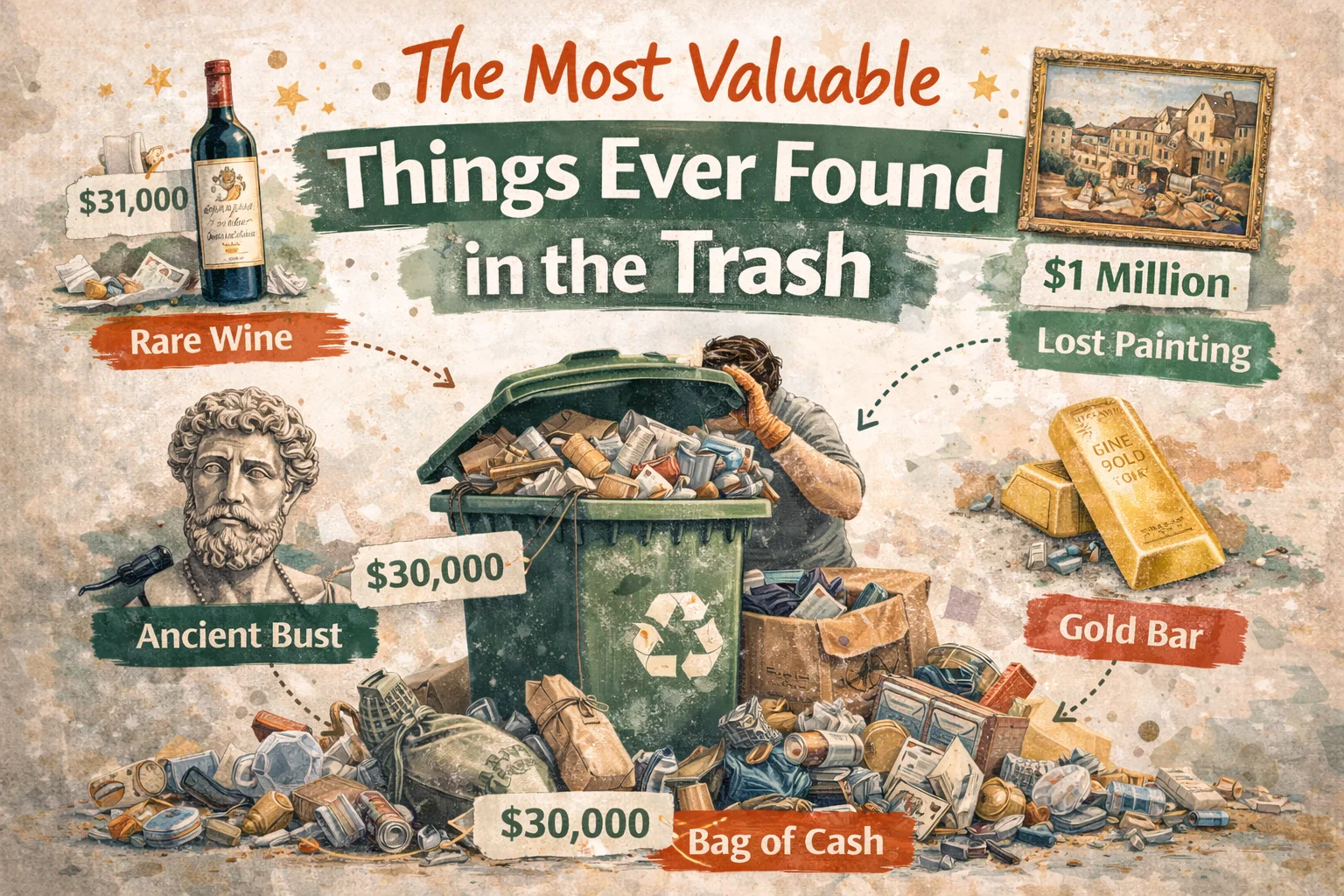
The common saying “one man’s trash is another man’s treasure” proved literal in numerous past cases across the UK. Waste operatives, market traders and curious members of the public spotted remarkable recoveries before items were lost for good.
This article lists past examples of rare finds from household bins, wheelie bins, commercial dumpsters, recycling streams and landfill. The scope covers cash and jewellery, historic artefacts, rare books and vintage tech that later reached auction houses and museums.
Readers will see how small decisions created expensive mistakes and learn practical lessons on disposal, record-keeping and ethical conduct when treasure appears. Expect concise case studies that explain how people recovered items and what happened next.
Key Takeaways
- Discoveries can be financial, cultural or collector-led.
- Waste streams like wheelie bins and recycling are common sources.
- Quick action often preserved the item’s value.
- Clear records reduce the risk of costly loss.
- There are legal and ethical steps to follow when recovering finds.
- Museums and auction houses often validate and rehome notable items.
Why “one man’s trash” sometimes becomes a literal treasure
Occasionally, a routine clear-out reveals an item that later draws collectors and high prices. A misread label, a hurried decision or a change in taste can turn an ordinary discard into a sought-after object.
How everyday disposal decisions create surprise value
People make costly errors during rushed house moves, renovations, spring cleans or while sorting possessions after bereavement.
These moments encourage quick choices and missed checks. A small box or forgotten shelf can hold an item that gains value over years.
Where the best finds happen
- Household bins and kerbside collections — easy to spot before compaction.
- Commercial dumpster areas — staff or passers-by may notice odd items.
- Recycling centres — trained workers can spot odd pieces before processing.
- Landfill — rarely recoverable once materials are compacted or buried.
Why past stories still matter
Markets shift, new collectors arrive, and technology or nostalgia change demand. A single overlooked object can later interest a collector or fund repairs to a house.
Quick checks and simple labelling help prevent regret and keep options open for later appraisal.
Valuable things found in trash that shocked people over the years
Some discarded parcels, mislabelled boxes or dropped bundles have gone on to become headline-making discoveries.
What counts as “valuable”
Worth here covers cash, rare books, jewellery, vintage tech, artworks and bespoke household fixtures.
Each category can bring a very different price tag and cultural interest.
Accidental versus deliberate disposal
Accidentally binned items often come from rushed moves, estate clearances or sloppy sorting.
Deliberate disposal happens when the owner judges an item broken, dated or unwanted.
How value is discovered
Sometimes a quick glance reveals a hallmark, stamp or brand. Other times, a hunch prompts closer inspection.
Many cases need expert appraisal at the right time to confirm authenticity and market price.
- Condition, provenance and demand all change an item’s market worth.
- Each story in this article doubles as a lesson about care, timing and legal duties.
- Even if an object appears abandoned, UK rules on ownership and reporting may still apply.
A first-edition Harry Potter thrown away by a journalist
A single careless decision by a journalist cost him a rare early print run of a cultural phenomenon.
Nigel Reynolds, the first journalist to interview J.K. Rowling, received a first edition copy of Harry Potter and the Philosopher’s Stone as a “thank you” and later discarded it. At the time the book’s success was not assured; only over the following years did first editions reach auction prices of up to about £50,000.
The “thank you” copy and why it mattered
Scarcity of early print runs, identifiable print markers and excellent condition make first editions highly sought by collectors. The early publication context — copies released before the series exploded — adds provenance and desirability.
Practical checks before you bin a book
- Check the publication year and publisher details.
- Look for first-edition print lines and the dust jacket condition.
- Note any numbered or limited-run indicators and any author inscriptions.
Hindsight, market shifts and collector behaviour
This story shows how quickly a book’s worth can change over years. A man might discard an everyday-looking copy and later regret it.
Quick checks at the time can stop a costly mistake and help preserve items that collectors prize.
Life savings lost in a wheelie bin and buried at landfill
A quiet morning in West Sussex turned into a devastating loss when an elderly resident accidentally threw away her life savings.
The West Sussex carrier bag containing £12,000
An older woman placed £12,000 in a carrier bag and, during a routine tidy-up, discarded it with rubbish. By the time she realised the missing money she had already contacted the site manager. The manager reported the bag was buried under thousands of tonnes of refuse and could not be retrieved.
Why landfill recovery is often impossible once waste is compacted and buried
Once waste leaves the kerb it is moved, compacted and spread across layers. Targeted retrieval is unsafe and impractical. Heavy machinery and mixed loads hide small items quickly.
| Stage | Typical action | Likely outcome |
|---|---|---|
| Bin collection | Transport to transfer site | Items mixed into bulk load |
| Landfill arrival | Compaction | Buried under tonnes of waste |
| Delay of hours | Less traceability | Recovery unrealistic |
Prevention tips:
- Do not keep large sums in a carrier bag; use a bank or sealed envelope.
- Label keep boxes clearly and separate them from rubbish zones.
- Check bins at the end of the day and act fast if something is missing.
This is a sobering story about how a short lapse can cost people their nest egg. It underlines simple steps to safeguard cash and important documents before disposal.
Diamonds mistakenly binned and the risks of trying to cash in
When small gems are wrapped in temporary packaging, even professional handlers can misplace them. A single disposal event once led to $5 million worth of diamonds being tossed with refuse.
How $5 million worth of diamonds ended up discarded
Loose stones were packed briefly during inspection and then accidentally mixed with ordinary waste. The size and temporary wrapping made them hard to spot until it was too late.
The security guard who tried to sell them — and why it failed
A security guard who retrieved the cache attempted to sell the gems on the black market. Without paperwork or clear provenance, law enforcement traced the sale and the guard faced criminal charges and asset seizure.
Proof of ownership and the finder dilemma
Finder’s keepers is not a defence. In the UK, lawful transfer and evidence of ownership matter. Improper private sale can lead to prosecution and the state returning items to their rightful owner.
- Document the discovery with photos and timestamps.
- Report the find to site management and police promptly.
- Avoid attempting private resale or removal that might hinder recovery.
| Action | Likely outcome | Advice |
|---|---|---|
| Attempt private sale | Criminal charges | Do not sell |
| Report to police | Formal trace and return | Document evidence |
| Keep silent | Asset seizure | Contact authorities |
This story shows that big finds come with complex ownership issues. Responsible steps give the best chance of getting items back to the rightful owner and avoiding legal harm to people who mean to help.
Gold jewellery thrown out by mistake during a household clean-up
Small, wrapped items can vanish during a house clear-out faster than you think — as one couple painfully discovered.

The $50,000 anniversary blunder
In the US, a husband called Geoffrey accidentally discarded about $50,000 worth of his wife’s gold jewellery around their 23rd anniversary. The pieces were wrapped and tucked away, so they looked ordinary. Only later did the couple realise what had gone.
Common ways jewellery gets binned: tissue, small boxes and “safe places”
Jewellery often slips into rubbish when it is wrapped in tissue, placed in a small box, put inside a carrier bag or hidden in a supposed safe place that is later forgotten.
- Practical UK advice: when decluttering, use one clearly labelled container for valuables rather than moving items between rooms.
- Before taking out trash, check lightweight bags and peep inside small boxes to confirm contents.
- Remember the human side: a mistake like this can strain relationships with a partner or friend, so prevention is worth the effort.
Key lesson: some of the most costly objects look insignificant once wrapped for storage, so slow down and check before you discard.
Vintage technology rescued from a recycling centre
Old computing gear can hide surprising historical value when it reaches a recycling tip. Early machines from major brands attract interest because they chart an industry’s rise.
The Apple-1 computer discovered at a recycling facility
In California a 1976 Apple-1 turned up at a recycling centre and later sold at auction for $200,000. Managers at the centre tried to trace the woman who had dropped it off so she could claim half the proceeds.
How auction value can jump to hundreds of thousands
Value grows over time as fewer units survive and collector demand rises. Original parts, documentation and clear provenance push prices much higher.
Shared proceeds and the challenge of tracking down the original owner
When ownership is unclear, disputes over proceeds can follow. Ethically and commercially, finding the original owner matters; it helps settle claims and avoids legal trouble.
- Why vintage tech becomes treasure: rarity, intact components and historical context.
- Practical UK advice: pause before you recycle electronics, check lofts and garages, and seek a specialist valuation if you spot an old model.
Worth is not always obvious. A quick look could send an important piece straight back to the recycling stream unless people pause and check first.
When modern art ends up in the rubbish
A routine clean at an Italian gallery turned into an awkward lesson when a cleaner mistook a sculpture for ordinary rubbish.
The piece by artist Paul Branca deliberately echoed two dustbins and a casual pile, aiming to prompt reflection on the environment. Valued at about $15,000, the work was removed and discarded during a busy changeover.
The cleaner who threw away a gallery artwork
This story shows how conceptual works can look like everyday objects and be misread. Without clear labels or briefing, even trusted staff may handle an installation as waste.
How galleries reduce risk
- Signage: clear labels explaining materials and intent.
- Briefings: staff updates before opening, cleaning or deinstallation.
- Barriers and inventory controls: rope, cones and checklists during busy times.
For venues and homeowners, practical steps help: label storage boxes, keep paperwork with each piece and separate cleaning supplies from displays. That way, an object is less likely to be misinterpreted and lost.
Conclusion: the Paul Branca story reminds us that meaning, documentation and the artist’s reputation shape market price and how people treat an object over time.
A winning fortune lost: the torn-up lottery ticket story
A single impulsive move on a stressful day can erase an enormous stroke of luck. This is the startling premise of a Las Vegas couple’s tale about a ticket that might have paid $915,000,000.
The Las Vegas numbers that could have won $915,000,000
A husband and wife played the same numbers. While waiting in line, the wife tore up the physical ticket and bought a quick “lucky dip” instead. Later the original numbers matched the mega-draw.
What this teaches about patience, process and keeping proof
Process matters. Keep tickets intact and record entries. Photograph numbers and store the ticket in one place until results are confirmed. These small steps cut the risk of self-inflicted loss.
| Action | Consequence | Advice |
|---|---|---|
| Tearing a ticket | Irreversible loss | Never destroy before checking |
| Buying a quick pick | Immediate relief, later regret | Wait until you confirm the first ticket |
| Not recording numbers | Dispute and doubt | Photograph or note the numbers |
The emotional cost of “what if?” moments
This story shows how a split-second choice can haunt people over time. The emotional toll can affect decision-making and quality of life.
- Store tickets together and photograph them.
- Avoid discarding paper until you confirm results.
- Give yourself a little extra time at the counter; patience often beats luck.
Household fixtures taken as trash: bespoke kitchen units collected by binmen
A short-term staging of kitchen cupboards outside a house led to an expensive misunderstanding. In South Tyneside electricians removed bespoke units to reach wiring and left them temporarily on the kerb.
The South Tyneside job that led to £10,000 of units being removed
On collection day a binman assumed the pile was for disposal. The crew collected the units as part of routine rounds and the family lost about £10,000 of fitted furniture.
How temporary piles are mistaken for rubbish
Kerbside placement often signals “set out for collection.” Crews have limited time and cannot verify ownership on the spot.
Worth in home fixtures is not obvious when units are used or partly dismantled. Passers-by and workers may assume something is trash, not salvageable joinery.
- Use clear signage such as “DO NOT REMOVE” attached to units.
- Move removable items to a secure area or locked garage while work is ongoing.
- Tell neighbours and the collection service about temporary placement on the day of work.
| Issue | Why it happens | Practical step |
|---|---|---|
| Pile left kerbside | Signals disposal to collectors | Label and cordon the area |
| Used-looking fixtures | Appear worthless to passers-by | Keep items covered and documented |
| Fast collections | Crews cannot verify ownership | Notify council or collection company beforehand |
Historic items discarded: an Enigma code-cracking machine dumped
During a routine intake at a recycling centre, staff almost processed a WWII Enigma code-cracking device as scrap metal. The machine carried both historical weight and a market value estimated at more than $10,000.
Why WWII-era equipment has cultural value as well as a price tag
Surviving wartime machines gain significance over the years as fewer complete examples remain. Museums and collectors prize items that illustrate wartime technology and social history.
Provenance can lift a piece from scrap to museum display. Clear ownership records and original paperwork improve both trust and price.
How artefacts slip into recycling streams
Estate clearances, institutional disposals or simple mislabelling can push important objects into the recycling flow. A hurried clear-out or a lack of specialist knowledge speeds this process.
What to do if you suspect an item is historically important
Pause and document. Photograph maker’s plates, serial numbers and any unique marks. Note where it was stored and any associated paperwork.
| Issue | Action | Outcome |
|---|---|---|
| Unknown wartime item | Stop disposal and photograph | Preserves context and aids ID |
| Museum interest | Contact local museum or reputable auction house | Formal appraisal and possible acquisition |
| No paperwork | Record storage history and seek specialist advice | Provenance research helps legitimacy |
If you suspect an artefact, contact local museums, reputable auction houses or specialist collectors. Quick action can save history and turn a near-loss into a proper story of rescue. At the time, a man or team who documents the find gives the best chance of a lawful and respectful outcome.
How people can avoid binning valuables and how finders can act responsibly
A quick check of bags and boxes can save hours of regret later. Small routines stop common errors during tidy-ups, moves and renovations.

Everyday prevention tips
- Final bag check: inspect opaque plastic sacks before leaving the house; run a hand through lightweight bags to feel for any hidden items or money.
- One keep box: use a dedicated box for things you want to keep and mark it clearly. Keep rubbish in a separate zone to avoid mix-ups.
- Label clearly: mark boxes with contents and owner details when decluttering or during tradesmen visits.
Secure disposal of personal documents
Shred bank statements, utility bills and any paperwork with personal data. Do not place financial information in an easily opened bag or an unsealed box.
What to do if you find an item near a dumpster, on the kerb or at a shared bin area
- Record where and when it was found and photograph the scene.
- Do not attempt an immediate private sale; contact site management or the police if the item is clearly valuable.
- Make reasonable efforts to return property back to the owner and keep a clear written record of your actions.
| Situation | Action | Outcome |
|---|---|---|
| Item beside kerb | Ask nearby neighbours or a friend before removing | Often returned quickly without formal steps |
| Found by dumpster | Document and notify site manager or police | Protects you legally and helps trace the owner |
| Once waste is collected | Act fast; landfill processing complicates recovery | Recovery may be impractical and ownership unclear |
When to call specialists
If an object appears historic or clearly valuable, contact auction houses, relevant collectors or local museums. Experts can assess provenance and advise on lawful next steps.
Human note: if a neighbour or friend may have lost something during a clear-out, asking locally often resolves the issue faster than formal channels.
Conclusion
Simple oversights during cleaning or renovation repeatedly produced big regrets for people across the UK.
Across the cases a clear pattern appears: routine choices can turn ordinary items into costly losses. A man or household may only spot the mistake after it is gone.
The range of things is wide: a rare book, life savings, diamonds, gold jewellery, vintage tech, modern art, bespoke fixtures and a wartime artefact all made headlines.
To avoid regret, slow down during clear-outs. Use labelled keep boxes, separate disposal streams and double-check lightweight bags before they leave the house.
Act quickly if you suspect a loss. Once an item reaches a dumpster collection route or the landfill, recovery is often unrealistic.
And if you come across something of value, handle it ethically and lawfully. Proper reporting protects you and gives the best chance the object returns to its rightful owner.
Apply these simple habits and you are far less likely to become the next cautionary tale.
 CALL NOW